
Why Roofing and HVAC Contractors Lose High-Value Leads to Poorer Rated Competitors
Why Roofing and HVAC Contractors Lose High-Value Leads to Poorer Rated Competitors
It is the ultimate frustration for any established business owner. You have spent a decade building a reputation, your trucks are clean, your technicians are certified, and your Google Business Profile boasts over 400 glowing 5-star reviews. Yet, when a homeowner searches for “roofing repair near me” or “emergency AC service,” you are nowhere to be found in the top three results. Instead, the “Map Pack” is dominated by a competitor with 22 reviews, a half-finished website, and a questionable local reputation. This isn’t a fluke; it is a symptom of a failing google business profile seo strategy. In my experience helping over 50 local brands dominate their markets, I, Umer Saeed, have seen this “Review Trap” destroy the lead flow of high-quality contractors who mistakenly believe that stars alone equal rankings.
The reality of the modern local search landscape is that Google’s algorithm does not reward the “best” business in the traditional sense; it rewards the business that provides the most mathematically relevant signals to its search engine. If you are being outranked by “poorer” competitors, it is because they are winning the technical battle of local search, even if they are losing the customer service one. To reclaim your spot, you must look beyond the stars and understand the mechanics of how to rank higher on google maps by addressing the three pillars of local SEO.
The Three Pillars of Local Ranking: Proximity, Relevance, and Prominence
To understand why your 400 reviews aren’t enough, we have to look at the three-legged stool that supports the Google Maps algorithm: Proximity, Relevance, and Prominence. Most contractors focus 90% of their energy on Prominence (reviews and brand mentions), completely ignoring the other two. When you neglect these, your google business profile seo becomes lopsided and eventually collapses.
Prominence is essentially your business’s popularity. This is where your reviews, backlinks, and news mentions live. Data shows that businesses with 15+ recent 4-5 star reviews appear in the local map pack 70% more often than those with stagnant profiles. However, Prominence is only one-third of the equation. If your google business profile optimization doesn’t account for the other two pillars, you will remain invisible to high-value leads.
Relevance is how well your business profile matches what the user is searching for. If a user searches for “ductless mini-split installation” and your profile only mentions “HVAC,” Google may pass you over for a competitor who has specific mentions of mini-splits in their services, updates, and reviews. Proximity, perhaps the most frustrating pillar, is how close your business is to the searcher. However, as we will discuss, proximity isn’t just about your physical address; it’s about the digital signals you send from the areas you serve. If “Proximity” or “Relevance” is broken, your 5-star reviews won’t save you from the second page of search results.
The “Three-Mile Wall”: Why Your Visibility Dies at the City Limits
One of the most common complaints I hear from HVAC and roofing contractors is: “I rank #1 when I’m sitting in my office, but as soon as I go three miles down the road, I disappear.” This is what we call the “Three-Mile Wall.” Because Google prioritizes proximity, it naturally wants to show the closest possible business to the user. For a service-area business (SAB) like a roofer, this is a major disadvantage because your “office” might be in an industrial park or a residential suburb, while your high-value leads are ten miles away in the affluent part of the city.
To overcome this, you need to understand that Why Roofing Companies Lose Thousands to Tiny Map Listing Errors often comes down to how Google perceives your service area boundaries. Many contractors simply check a few boxes in their dashboard and hope for the best. To actually push your “map pin” further, you need to increase your “signal density” in those outlying areas. This involves generating interaction logs – Google tracks when users from specific zip codes interact with your profile.
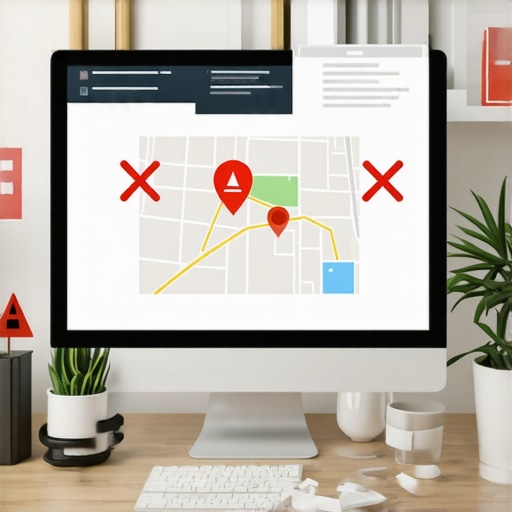
If you want to visualize this “dead zone,” you should use a google maps rank tracker. These tools provide a grid-based view of your rankings, showing exactly where your visibility drops off. By identifying these gaps, you can tailor your local content and backlink strategy to “poke” through the wall. Without this data, you are essentially flying blind, wondering why your reviews aren’t traveling as far as your trucks do. For more on this, see our guide on 3 Specific Reasons Your Google Business Profile Isn’t Ranking in the Local Pack.
Technical Gaps: The Silent Killers of High-Value Leads
While you are focused on getting the next 5-star review, your competitor might be winning because their technical foundation is superior. Technical google business profile seo is often invisible to the business owner but glaringly obvious to Google’s crawlers. The two biggest culprits here are NAP (Name, Address, Phone) inconsistency and missing Schema markup.
NAP consistency is the bedrock of local trust. If your business is listed as “Main St. Roofing” on Google, “Main Street Roofing, LLC” on Facebook, and “Main St Roofing & Gutters” on Yelp, Google begins to lose confidence that these are the same entity. A data point we frequently cite in our audits is how a simple phone number change or an unverified address update can make a map pin disappear overnight. Google’s algorithm is risk-averse; if it sees conflicting data, it will rank the “safer” (more consistent) business – even if that business has fewer reviews.
Furthermore, many contractors fail to use Local Business Schema. This is a snippet of code on your website that tells Google exactly what your service area is, what your hours are, and which reviews are verified. Proper google business profile optimization requires technical local seo software to ensure that the data on your website perfectly aligns with your GMB profile. Without this alignment, Google may not “trust” your service area enough to show you to distant leads. For a deeper dive into these technicalities, read about The Specific Schema Fixes That Help Google Trust Your Service Area.
The Content Depth Strategy: Proving You Are the Local Authority
Most HVAC and roofing websites suffer from “Thin Content Syndrome.” They have a homepage, a contact page, and maybe a few generic service pages that look exactly like every other contractor’s site. If you want to rank higher on google maps, you must prove to Google that you are a “Hyper-Local Authority.”
Google’s algorithm has evolved to recognize “Local Signal Depth.” This means that having a page for “Roofing in Dallas” isn’t enough anymore. To dominate, you need content that mentions local landmarks, local weather patterns (like hail damage in specific neighborhoods), and local building codes. This is the difference between a generic landing page and a high-converting local asset. When your website provides deep, localized information, it reinforces your google business profile seo by creating a web of relevance that Google cannot ignore.
We often see city landing pages “ghosted” by Google because they lack this hyper-local relevance. They are seen as “doorway pages” rather than helpful resources. By implementing a Hyper-Local Link Strategy – where you earn links from local Little League teams, neighborhood associations, or local chambers of commerce – you force Google to recognize your service area. This is a key part of the Maps Ranking Boost Blueprint that separates the market leaders from the also-rans. You can learn more about The Truth About Why Your Competitors Dominate Google Maps With Fewer Reviews by looking at their content depth.
Engagement Signals: The Secret to Outranking “Big Box” Competitors
One of the most misunderstood aspects of google business profile seo is the role of user engagement. Google isn’t just looking at what you say about yourself; it’s looking at how the world interacts with you. These “Interaction Triggers” are often the reason a smaller competitor can leapfrog a “Big Box” contractor with 1,000 reviews.
Google tracks several key engagement signals:
- Click-to-Call Rate: How many people click your phone number after seeing your profile?
- Direction Requests: Even for service-area businesses, direction requests signal that people are interested in your physical location.
- Review Velocity: It is better to get 5 reviews a month consistently than to get 50 reviews in one week and then nothing for six months.
- Photo Views: Profiles with frequently updated, high-quality photos of real work (not stock photos) see significantly higher engagement.
A profile with fewer reviews but higher “Review Velocity” and active engagement will often outrank a stagnant profile with 1,000 old reviews. This is because Google wants to provide “fresh” results. If your profile hasn’t had a new photo or a new review in three months, Google assumes you might be less active or less relevant than the “hungrier” competitor down the street. To maintain your edge, you need a google maps ranking service that focuses on consistent signal generation, not just a one-time setup.
Conclusion: Breaking the Map Pack Limbo in 2026
The gap between a high-rated contractor and a high-ranking contractor is filled with technical nuances and algorithmic signals. As we move toward the 2026 algorithm shift, the importance of “Local Signal Depth” will only increase. Google is moving away from generic directory citations and moving toward rewarding businesses that demonstrate true local authority and consistent user engagement. If you are stuck in “Map Pack Limbo,” it is time to stop waiting for your reviews to do the heavy lifting.
Ranking on Google Maps is a race of signals, not just a contest of stars. To reclaim your leads, you must address your proximity gaps, fix your technical NAP and Schema errors, and build a content strategy that proves your local relevance. Whether you choose to perform a manual google business profile audit or hire a professional google maps ranking service, the first step is admitting that the old way of “just get more reviews” is no longer enough.
Don’t let poorer-rated competitors steal your high-value roofing and HVAC leads. By understanding the three pillars of local search and investing in a comprehensive google business profile seo strategy, you can ensure that your business is the one homeowners see first when they need help the most. The leads are there – you just need to make sure Google knows exactly where to find you.