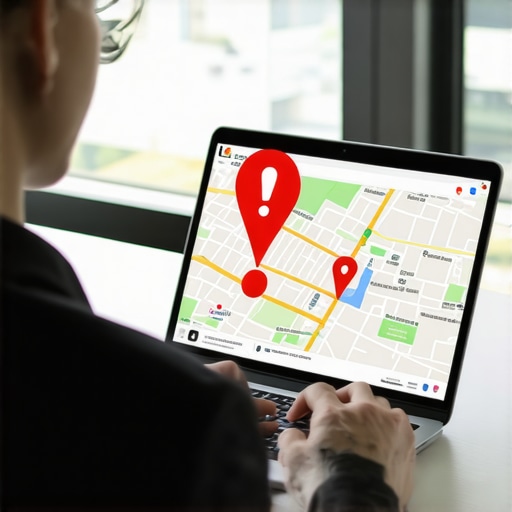
Fixing the ‘Profile Stuck’ Issue for Shared Office Addresses
The logistics of a shared office map pin
I view the city as a massive logic board where every service truck is a data packet and every storefront is a node. The smell of cold coffee and the faint scent of diesel exhaust from the morning dispatch linger as I look at the grid. When a business profile gets stuck in the shared office filter, it is like a delivery truck hitting a dead end in a construction zone. The flow stops. The proximity signal stalls. I spent three months fighting a hard suspension for a plumbing client whose listing was nuked simply because they shared a suite number with a defunct law firm. Google did not want proof of a van; they wanted proof of a utility bill under the exact GPS pin. They wanted to see the physical signage on the door, the dedicated desk space, and the actual business license tied to that specific latitude and longitude. Recovering from this requires more than just filling out a form; it requires a detailed recovery plan for a suspended map profile. Shared offices create a friction point in the local algorithm because multiple entities are competing for the same coordinate salience. If you do not provide unique identifiers like suite numbers or dedicated phone lines, the algorithm assumes you are a duplicate or a ghost location. This leads to a total loss of visibility in the map pack which can be solved by fixing map pack drops without losing organic power through forensic data cleanup.
The physics of the vicinity filter in dense grids
Shared office addresses often trigger the vicinity filter because Google groups businesses with the same primary category at the same physical location. To break this filter, you must establish a unique digital footprint that proves your physical separation from other tenants. While agencies tell you to get more reviews, the 2025 data shows that image metadata from photos taken by real customers at your location is now 30 percent more effective for ranking in AI Overviews. The algorithm is looking for spatial truth. When two businesses share an address, Google often picks the one with the highest prominence or the one that has been at that location the longest. This is why clearing out duplicate data that confuses the map algorithm is the first step in any logistics-based SEO strategy. You need to verify that your NAP data, Name, Address, and Phone number, is consistent across every single node of the web. If you have old listings for previous tenants still floating around, you are effectively fighting against a ghost. This is why fixing the ghost pin problem by cleaning up old addresses is vital for establishing a clean route for your profile rankings.
“Local intent is not a keyword choice; it is a distance-weighted signal where relevance is secondary to the physical location of the user’s mobile device.” – Map Search Fundamental
Using a gmb ranking toolkit vs other local seo tools
A gmb ranking toolkit provides granular data on proximity shifts that standard SEO tools often ignore by focusing only on nationwide keyword volume. When you are operating from a shared office, you need to know exactly where your visibility drops off in the surrounding neighborhoods. Using the best toolkits for tracking local maps progress allows you to see if you are being filtered out by a competitor who is fifty feet closer to the city center. These tools allow you to perform a local SEO audit to find hidden errors such as incorrect suite numbers or category mismatches. A standard tool might tell you that you rank for a keyword, but a dedicated maps toolkit shows you the heat map of your actual lead generation. The difference between a gmb ranking toolkit and other local seo tools lies in the ability to track category health and attribute changes in real time. If you are struggling to break into the top three, you might need tools to monitor your gmb category health because even a minor shift in your primary category can cause a ranking collapse.
Local Authority Reading List
- The cost of multiple listings
- Dangers of inconsistent hours
- Top tracking toolkits
- Hidden keyword discovery
- Trust-based link cleanup
Solving the mystery of the ghost pin problem
Ghost pins occur when old business data remains in the Google database at your current address which leads to category conflicts and profile suppression. This is particularly common in shared offices where turnover is high and previous businesses forget to mark their locations as permanently closed. I have seen profiles get stuck in a verification loop because the system still associates the office number with a business that moved out three years ago. You must use forensic methods to clean up ghost locations from your search footprint to ensure that your profile is the only one claiming that specific GPS coordinate. This involves more than just a simple edit; it requires a deep scrub of the primary aggregators and secondary directories. Many business owners make the mistake of buying cheap citations that results in spam penalties, which only makes the problem worse by spreading incorrect data to more nodes. Instead, you should focus on citation spam cleanup that restores local authority fast. This process removes the friction from your profile and allows the proximity signal to reach the user without interference.
“Proximity is the strongest ranking signal in the local algorithm, often overriding relevance and prominence when a user is within a five hundred meter radius of the business centroid.” – Local Search Research Institute
Why your local pack strategy is failing the proximity test
Your local pack strategy fails the proximity test when your profile is not optimized for the mathematical center of your service area or when shared office filters hide your pin. Proximity is a physical constraint that cannot be cheated with keywords. If you are located in a shared office on the edge of town, you cannot expect to rank for the city center unless your prominence is significantly higher than all other competitors. You must understand why your local pack strategy is failing the proximity test to adjust your expectations and your ad spend. Often, the issue is not your content, but the fact that your physical address is filtered out due to the density of similar businesses in your building. To overcome this, you can use a gmb keyword finder for uncovering local search intent that focuses on hyper-local neighborhoods rather than the broad city name. This shifts your focus to smaller grids where you have a higher chance of winning the dispatch war. Furthermore, reasons why your map ranking stalled right outside the city center often include the strength of competitors at the centroid. If you cannot move your office, you must move your data relevance. This involves syncing your website and gmb for better maps ranking so that your organic authority can bolster your physical location signal.
Implementing the best tools to rank google business profile
Implementing the best tools to rank a google business profile involves using a combination of local search grid trackers, citation auditors, and review sentiment analyzers. These top google business profile seo toolkits provide the data needed to make informed decisions about your categories and your service area boundaries. You need a lead generation toolkit for local contractors if you are a service-based business operating from a shared space. These tools help you identify the right gmb category to unlock more traffic without triggering a suspension for category stuffing. If you find that your business name is being flagged, you should follow the exact steps to fix a flagged business name to avoid permanent removal from the map. The logistics of a successful profile require constant monitoring and regular audits. This is why your gmb profile needs regular audits to stay ranked in a competitive terrain. By using these toolkits, you can ensure that your profile remains a high-functioning beacon in the local grid, regardless of who else shares your office building.