Why Your Address Update Hasn’t Fixed Your Map Placement Yet
Why Your Address Update Hasn’t Fixed Your Map Placement Yet
Moving your business to a new location is a monumental task. Between signing a new lease, moving equipment, and notifying your current clients, the logistics are enough to overwhelm even the most seasoned entrepreneur. However, for many local business owners, the real headache begins after the move. You log into your dashboard, update your physical location, and wait for the “pin” to move. You expect your rankings to follow you to your new neighborhood. Instead, you find yourself invisible.
The frustration of seeing your business disappear from the local pack is real. You’ve done everything “by the book,” yet your google business profile seo seems to have hit a brick wall. This phenomenon isn’t just bad luck; it is a calculated response by the Google algorithm. Many business owners operate under the misconception that an address change is an “instant update.” In reality, Google often treats a change of address as a “high-risk action,” which can trigger a 30-day indexing delay or even a total visibility lag.
As a specialist who helps businesses identify the specific reasons a Google Business Profile isn’t ranking, I see this daily. If you’ve updated your address but haven’t seen your map placement recover, you are likely caught in the “Trust Gap.” In this guide, I will break down why this happens and how you can use a google maps ranking service or specialized local seo tools to force Google’s hand and regain your visibility.
The “Trust Gap”: Why Google Doesn’t Believe You Just Yet
Google’s primary goal is to provide users with accurate, reliable information. When you change your address on your Google Business Profile (GBP), you are essentially telling the algorithm that a fundamental piece of its “knowledge graph” regarding your business has changed. Google doesn’t just take your word for it. It enters a period of verification where it attempts to validate the move using an automated checking system.
This is where the “Trust Gap” occurs. If your google business profile optimization efforts are focused solely on the GBP dashboard, you’re missing the bigger picture. Google’s crawlers are looking at the rest of the web to see if the new data matches the old. If your website, social media profiles, and major directories still point to your old location, Google enters a state of “data conflict.” In the eyes of the algorithm, a conflicting address is a sign of potential spam or a hijacked listing.
Expert local SEO practitioners, including industry leaders like Darren Shaw, often emphasize a “web-first” approach. You must update the “web” – meaning your website’s footer, your contact page, and your social media headers – before you touch the GBP dashboard. When Google sees the new address on authoritative sources first, the transition within the GBP environment is much smoother. Without this synchronization, your google business profile seo will suffer from a prolonged “verification lag.” To audit how the web sees your business, using a google business profile seo tool is essential to identify where these data conflicts reside.
The NAP Consistency Crisis: Why Your Old Address is Haunted
NAP stands for Name, Address, and Phone number. In the world of local search, NAP consistency is the currency of trust. When you move, you don’t just leave behind a physical building; you leave behind a trail of digital breadcrumbs. These “citations” on sites like Yelp, Yellow Pages, and Bing Maps act as “anchor weights.” If they still point to your old address, they are actively pulling your new location’s ranking down.
The data regarding this is clear and unforgiving. Research indicates that 73% of local businesses have citation inconsistencies that directly suppress their rankings. Google’s algorithm uses these citations to triangulate your location and authority. If 70% of your citations say you are on “Main Street” but your GBP says you are on “Second Avenue,” Google loses confidence in your new location’s legitimacy. Conversely, businesses that maintain full NAP consistency across the top directories see an average of 2.3x more local-pack appearances.
It is not enough to just update the big players. You need to address “unstructured mentions” as well. While directory citations are the foundation, unstructured mentions often move the needle more in modern local SEO. These are mentions of your business name and new address in local news articles, blog posts, or community event pages. To manage this massive cleanup, most professionals rely on local seo tools to scan the web for every iteration of their old address. If you want to rank google business profile listings effectively after a move, you must exorcise the “ghosts” of your old address from the internet. Using local seo tools can automate the discovery of these outdated mentions, saving you dozens of hours of manual searching.
Proximity, Relevance, and the 2026 Algorithm Shift
One of the most common complaints I hear is: “I moved only two miles away, why did my rankings drop?” To the human mind, two miles is nothing. To the Google Maps algorithm, two miles can represent a completely different competitive “grid.” When you move, the “math” of the Map Pack changes instantly. Your business is now being measured against a new set of competitors and a new set of proximity markers.
As we look toward the 2026 algorithm landscape, we are seeing the rise of concepts like “Signal Lag” and “Node Syncing.” Google’s infrastructure is moving toward a more real-time analysis of “proximity authority.” In the past, you might have had a high “relevance” score for your old coordinates because you had years of data showing people searched for you and visited you at that spot. When you move, you lose that historical proximity data. You are essentially starting from zero in your new “node.”
To rank higher on google maps in a new location, you have to build “proximity authority” from scratch. This means you need to generate new signals that are specific to your new coordinates. The algorithm is looking for “Interaction Triggers” – users searching for your business from within a 1-mile radius of the new shop, or people asking for directions to the new address. If you don’t proactively trigger these signals, you will be stuck in a state of “Signal Lag” where Google knows where you are but doesn’t think you are relevant to the new neighborhood yet. You can beat the 2026 proximity filter by focusing on hyper-local signals. To monitor how your proximity authority is growing, you should use a tool to rank higher on google maps and track your progress across a localized grid.
Troubleshooting the “Ghost Pin” and Map Lag
Sometimes, the address update appears successful – the map shows your new location – but your rankings are nowhere to be found. This is a technical state known as “Map Lag.” Your business exists in a vacuum where the “front end” (what users see) is updated, but the “back end” (the ranking engine) is still processing your historical data. You might even see a “Ghost Pin” where your business shows up for direct name searches but fails to appear for categorical searches like “dentist near me.”
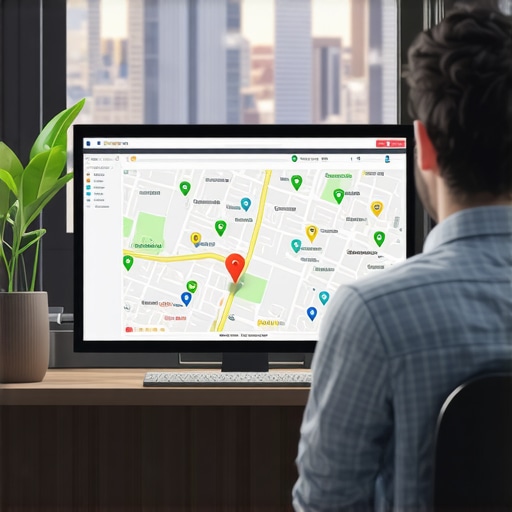
The first step in troubleshooting this is to stop guessing. You need to use a google maps rank tracker to see exactly where your visibility starts and ends. Are you ranking within 500 feet but failing at 1 mile? This data tells us if the issue is a lack of authority or a technical indexing error. If the rank tracker shows you are completely unranked even at your front door, you have an indexing lag.
To break this lag, you need to force Google to re-crawl and re-evaluate your profile. The most effective way to do this is through “Interaction Triggers.” Start by uploading 5-10 high-resolution photos of the new location – both interior and exterior (including the street sign if possible). These photos contain geotags that help Google’s AI confirm your physical presence. Next, encourage your most loyal customers to leave reviews that specifically mention your new neighborhood or street name. This creates a text-based association between your brand and the new location. If your efforts feel stalled, utilizing a professional google maps rank tracker will provide the granular data needed to see if these triggers are working. For those who need immediate results, a dedicated strategy to accelerate GBP signals is often the only way to bypass the standard 30-day wait period.
The 5-Step Recovery Checklist
If your address update hasn’t fixed your map placement yet, you need a systematic approach to regain your google business profile ranking. Don’t wait for Google to “eventually” find you. Use this checklist to force the update through signal depth.
1. Update Website Schema
Your website is your primary source of truth. Ensure your LocalBusiness Schema markup is updated with the new address, latitude, and longitude. This technical code tells Google’s bots exactly where you are in a language they prefer. Many businesses fail to rank because of specific schema gaps that prevent the algorithm from connecting the website to the GBP profile.
2. Audit Top 50 Citations
You don’t need to update every obscure directory on the planet, but you must fix the top 50. This includes Yelp, Apple Maps, Bing, and industry-specific sites (like TripAdvisor for restaurants or Avvo for lawyers). Use local seo software to find and fix these inconsistencies quickly.
3. Trigger “Signal Beaconing”
Signal beaconing is the process of generating fresh, local data points. Ask your customers to check in on social media at the new location. Run a small local ad campaign targeting a 3-mile radius around your new office to increase google business profile visibility. This creates the “user interaction” signals Google needs to trust your new location.
4. Embed the New Map
Update your “Contact Us” page with a new Google Maps embed of your updated listing. This creates a direct API link between your site and your GBP. Be careful, as a map embed error can actually destroy your proximity relevance if not handled correctly.
5. Monitor with Local SEO Software
You cannot manage what you cannot measure. Use local seo software to track your “Ranking Accelerator” progress. Monitor your keyword positions across a grid to see if your “proximity bubble” is expanding or shrinking. This allows you to adjust your strategy in real-time rather than waiting weeks for the GBP dashboard to update.
Conclusion: Regaining Your Local Pack Dominance
An address change is one of the most volatile events in the life of a Google Business Profile. While it is a “high-risk action” that can lead to temporary invisibility, it is not a permanent sentence. The “Map Lag” you are experiencing is simply the algorithm’s way of asking for more proof. By closing the “Trust Gap,” fixing your NAP consistency, and generating fresh proximity signals, you can accelerate the re-ranking process and get more calls from google maps than ever before.
The 2026 SEO environment doesn’t reward those who wait; it rewards those who provide the most “signal depth.” Don’t let your business stay a “Ghost Pin” in a new neighborhood. If you are struggling to see movement, it may be time to use a google business profile audit tool to find the hidden anchors holding you back. For business owners who want to bypass the stress and technical hurdles, seeking a professional google maps ranking service or a comprehensive google business profile audit tool is the fastest path back to the top of the Map Pack. My name is Shahid Anwar, and I specialize in helping businesses turn these ranking dips into opportunities for local dominance. Let’s get your pin back where it belongs.