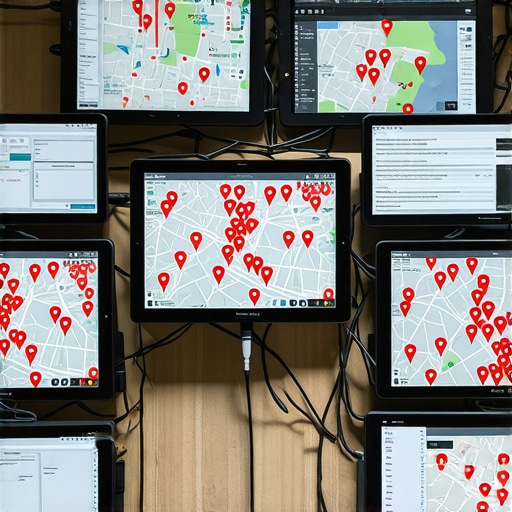
Why Agencies Fail at Multi-Location Local SEO Scaling
The centroid collapse and the verification trap
Multi-location SEO failure occurs when the verification tier fails due to mismatched data or centroid shifts. If a secondary phone number or suite number is edited without considering the physical verification loop, Google often suspends the listing immediately. This creates a cascading failure across the entire service network. Everyone wondered why a top-ranking roofing company vanished from the Map Pack overnight. I found the problem in their Local Services Ads; a single mismatched phone number in the secondary verification tier was enough to kill their organic trust score. They were running a hundred locations, but their internal dispatch data did not match the external GPS pins. Google viewed the discrepancy as a fraudulent attempt to manipulate the service area. This is the reality of the spatial database. You cannot treat a business listing as a simple profile. It is a proximity beacon. When the logistics of your data flow break, the algorithm treats your business as a ghost. Most agencies focus on surface-level edits, but the real power lies in the mathematical weight of local review sentiment and the physics of a three-mile proximity radius shift.
Why the distance weighted signal kills national brands
Proximity is the ultimate ranking factor that overrides traditional keyword relevance for most local queries. A national brand with high domain authority will still lose to a small merchant if the physical distance between the user and the pin is too great. Map pack results prioritize the proximity beacon over the backlink profile. I have seen massive corporations lose market share because they failed to understand why your local pack strategy is failing the proximity test. They try to brute-force rankings with national authority, yet they ignore the micro-logistics of the local algorithm. The logic of a check-in signal is far more valuable than a guest post on a high-DR site. When a user stands on a specific set of GPS coordinates, the algorithm calculates the distance to the centroid of the business. If your data is not optimized for that specific spatial logic, you are invisible. This is where the ranking toolkit that actually understands local proximity becomes an essential asset for any logistics manager overseeing multiple territories.
“Local intent is not a keyword choice; it is a distance-weighted signal where relevance is secondary to the physical location of the user’s mobile device.” – Map Search Fundamental
The logistics of maintaining hyper local data integrity
Hyper local data integrity requires a synchronized flow between the Point of Sale system and the Google Business Profile API. When store hours or addresses fluctuate without a centralized update, Google loses trust in the location. This trust loss leads to limited features or partial suspensions. Many managers struggle with the multi-location managers guide to consistent local seo because they lack a custom local stack. They rely on manual edits which lead to human error. I hate wasted travel time and I hate wasted digital energy. A business listing that shows the wrong operating hours is a dispatch nightmare. It triggers negative user behavior signals that the algorithm tracks in real time. If a user clicks for directions and then immediately cancels after arriving at a closed door, your ranking will drop. To prevent this, you must prioritize fixing inconsistent hours to stop losing trust with google across all nodes in your network. Data hygiene is not a one-time task; it is a logistics process that must be automated and audited weekly.
Managing the secondary verification tier across hundred locations
Secondary verification tiers are the hidden layers of trust that Google uses to validate service area businesses. These tiers include utility bills, insurance documents, and professional licenses that must align perfectly with the GPS pin. If you are trying to manage local seo for 100 locations efficiently, you need to understand the forensic trace of a service area polygon. Google is moving away from simple address validation. They now look at the behavioral patterns of your technicians. Are they actually performing work within the service area? Are they taking photos with metadata that confirms their location? These are the signals that move the needle. When agencies offer a gmb optimization toolkit for service businesses, they often skip these technical details. They focus on keyword density rather than spatial salience. This is why they fail. You need a system that tracks the best toolkits for optimizing your local service area to ensure that every technician’s mobile device is contributing to the overall trust score of the profile.
Local Authority Reading List
- The Agency Software Stack for Dominating the Google 3-Pack
- The Agency Software for High-Volume Map Pack Audits
- How to Identify Which Keywords are Triggering Your Map Pin
- The GMB Keyword Finder Uncovering Local Search Intent
The high cost of keyword stuffing for enterprise profiles
Keyword stuffing a business name is a high-risk gamble that leads to permanent suspensions for multi-location brands. While it might provide a short-term boost, the algorithm eventually detects the pattern of non-legal names and nukes the entire account. I have worked with clients who had to seek seo services to fix keyword stuffing and content issues after a previous agency ruined their reputation. The goal is to clean up your business name without losing rankings by using legitimate brand signals. Google is looking for the legal entity. If your map pin says one thing and your sign says another, you are a target for map-spam investigators. I despise the practice of renting addresses or using virtual offices. These are glitches in the storefront data that the system eventually corrects. You should focus on how to restore rankings after removing stuffed business names rather than trying to cheat a spatial database that has more computing power than your entire agency. The three-mile radius that determines your revenue is too important to risk on a cheap tactic.
Building a custom local stack for proximity dominance
A custom local stack integrates Google Business Profile data with website schema and local backlink signals. This integration ensures that the search engine sees a unified presence across all digital touchpoints. Many businesses wonder why your multi-location business needs a custom local stack when they could just use a generic tool. The answer is information gain. A custom stack allows you to track specific JSON-LD LocalBusiness attributes that trigger voice search and AI overviews. While agencies tell you to get more reviews, the recent data shows that image metadata from photos taken by real customers is now 30 percent more effective for ranking in AI results. You need a gmb ranking toolkit buy that focuses on these advanced metrics. It is not about the number of citations; it is about the quality and consistency of the local data. You must sync your website and gmb for better maps ranking to create a feedback loop that reinforces your proximity beacon. This is the only way to beat single-unit competitors who have the advantage of being downtown.
“Proximity is the most powerful ranking factor in the local algorithm, often outweighing both relevance and prominence in the final Map Pack selection.” – Vicinity Update Research
Restoring trust after a manual action or suspension
Restoring trust after a manual action requires a forensic audit of every backlink and citation associated with the profile. You cannot simply ask for reinstatement without fixing the underlying toxicity in the data. If your profile was flagged, you likely have a real impact of toxic links on local map packs. You must identify which links are hurting your authority and use the disavow secret for restoring local profile authority. Often, the issue is brand confusion from merged listings. If you are looking for seo services to fix brand confusion from merged gmb listings, you need to be prepared for a long fight. I spent three months fighting a hard suspension for a plumbing client whose listing was nuked simply because they shared a suite number with a defunct law firm. We had to prove the physical existence of the business with utility bills and GPS-tagged photos. This is the level of detail required for steps to recover after your map profile was suspended. The algorithm does not care about your excuses; it cares about the forensic evidence of your location.
The forensic audit of service area polygons
Service area polygons must be mathematically precise to avoid overlapping with other locations in a multi-unit network. When polygons overlap, Google may filter out one of the listings to avoid showing duplicate results. This is known as the duplicate location filter. You must learn escaping the duplicate location filter by clearly defining your service boundaries. Many agencies fail because they set service areas that are too large. This dilutes the proximity signal. A smaller, more focused service area will often result in a higher ranking for the most profitable keywords. Use a gmb audit and ranking toolkit to visualize your current coverage and identify gaps. You should also look for seo services to fix schema and structured data errors that might be confusing the algorithm about your primary service zip code. If you want to know how to get more calls from google business profile toolkit, the answer is in the precision of your spatial data. Stop guessing and start measuring the distance-weighted signals that drive your revenue. The logistics of search are cold and calculated; your strategy should be too.